
What's a good average watch time on reels? Mine held 30 to 38 s
Instagram's definition, what good looks like at each reel length, and the real averages of five Claude Code reels that passed 1M views.

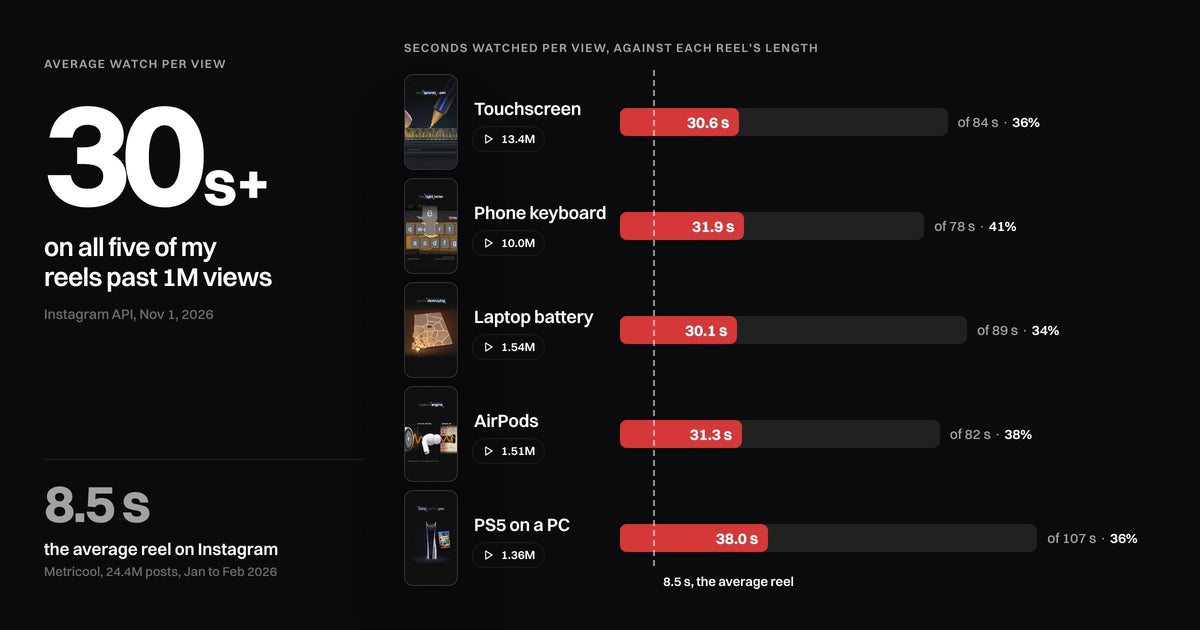
Average watch time is how long one view of your reel plays, on average: Instagram divides the total watch time, replays included, by the reel's initial views. A good one beats the typical reel of the same length, and the typical reel in 2026 holds 8.5 seconds (Metricool). My five Claude Code explainers that passed 1M views held 30.1 to 38.0 seconds each, 34 to 41% of reels 78 to 107 seconds long (Instagram API, Nov 1, 2026).
- Read it two ways: in seconds and as a share of the reel's length. Instagram looks at both.
- Good depends on length. Reels under 15 s hold about 66% of their length, reels over a minute about 16% (Highviz, 346 reels, Aug 2026).
- A high percentage can hide a weak reel. My old 8-second posts held 69% of their length, a median 5.7 s, and got a median of 3,075 views.
- What held people: the subject on screen and moving at frame 0, and a picture that changes on each word. Claude Code builds both with Full Visual.
What average watch time means on Instagram
Average watch time is the number of seconds each view of your reel played, on average. Instagram's reels insights page calculates it as "the watch time divided by the number of initial views", where an initial view is "when your reel starts to play for the first time in a reel session" (read Nov 1, 2026).
Watch time counts replays and initial views don't, so a short reel that people loop can show an average longer than the reel itself.
To see yours, open the Reels tab on your profile, tap the reel, then View insights. The numbers in this post come from the same metric through Instagram's API.
On my touchscreen reel, total watch time adds up to 97,054 hours, about 11 years of people watching, for an average of 30.6 s (API, Nov 1).
Go deeper: views, viewers, watch time and skip rate
Views count every start and replay. Viewers count unique accounts that had the reel on screen, played or not. Watch time is the total time played, replays included. Skip rate is the share of initial views skipped in the first 3 seconds, per Meta's API reference, which calls it estimated and in development. On the touchscreen reel, 97,054 hours divided by 30.6 s works out to about 11.4M initial views against 13.4M views, so roughly 2M were replays. That split is my arithmetic, not a number Instagram shows.
What is a good average watch time for Instagram reels?
A good average watch time is one above what reels of the same length usually hold. Instagram publishes no benchmark. The clearest public numbers by length come from Highviz, which read 346 reels from 108 accounts (updated Aug 20, 2026).
| Reel length | Typical share held | In seconds | My reels at that length |
|---|---|---|---|
| Under 15 s | 66.0% | About 6.6 s on a 10 s reel | Old format, 7 to 10 s: 69%, a median 5.7 s |
| 15 to 30 s | 31.5% | About 7 s on a 22 s reel | No explainer at this length |
| 30 to 60 s | 22.1% | About 10 s on a 45 s reel | Tire hairs explainer, 55 s: 29.5 s, 54%, 167K views |
| Over 60 s | 16.4% | About 15 s on a 90 s reel | Five explainers past 1M: 30.1 to 38.0 s, 34 to 41% |
Across every length, Metricool's study of 24.4M posts from 375,118 accounts puts the average reel at 8.5 seconds in January and February 2026, more than double a year earlier (Jun 16, 2026).
So on a reel past a minute, about 15 s is typical, and my explainers held more than twice that share. Check your own last ten reels too: same audience, same niche, a fairer bar than anyone's average.
Seconds or percent: why a high percentage can still mean a weak reel
Percent flatters short reels: an 8-second reel holds 69% of its length on under 6 seconds of attention. Instagram looks at both. "We look at not only the percentage of a video that was watched, but also the number of seconds," Adam Mosseri said (quoted by Social Media Today, Feb 25, 2025).
The share halved and the seconds went up more than five times. Over the same switch, my median post went from 3,075 views to 69,913 (API, all 30 posts from Sep 28 to Oct 21, as of Oct 21). That's one account, and the subject changed too, so read it as a correlation.
Watch time doesn't pick the winner on its own. My highest average above 100K views, 52.4 s on the 149 s Pliny the Liberator reel, got 475K views. The touchscreen held 30.6 s and got 13.4M. Instagram also weighs shares and likes: the Instagram algorithm in 2026, checked against these reels.
How to increase average watch time on Instagram reels
Two things held people on every reel past 1M: the first frame was already the subject, already moving, and the picture changed on each word.
Frame 0 is the subject, in motion. No logo, no title card, no black screen. Instagram's own advice to creators is a hook "in the first 3 seconds" (Feb 26, 2025), and skip rate measures exactly those seconds.
 Keyboard, frame 0A thumb already coming down on the keys.
 Battery, frame 0The charger plug, already turning in the light.
Before a word is spoken, the viewer is already looking at the thing the reel is about.
The first line asks a question the viewer can't answer. "Every key on your iPhone keyboard is smaller than your thumb and you still hit the right letter almost every time. So how is that possible?" Seven openings like it, word for word: reel hooks that got 110K to 13M views.
The picture changes on the word. In the PS5 reel, the game box appears beside the console on "Sony", the disc pops out on "stop", the box breaks apart on "games", the console splits open as a crowd of avatars flies in on "community", and they circle the rebuilt console on "PS5". There's always something new to look at, and it's always the thing being said.
 “Sony”
 “stop”
 “games”
 “community”
 “PS5”
By hand, in CapCut or Premiere Pro, each of those changes is a cut or a keyframe you place yourself on its word. Length is a separate lever, covered with every post's numbers in how long a reel should be.
How Claude Code makes reels that hold 30 seconds
Every reel in this post is an animated explainer written by Claude Code with Full Visual and rendered to an MP4. Claude Code writes each scene as code against the voice, so the subject is on screen from the first frame and each picture lands on its word. I don't place a single keyframe.
You bring a subject, a link or your own transcript, and get back the finished reel, its caption and the project to edit. The voice runs on your own ElevenLabs, OpenAI or Fish key. The whole workflow at viewer level: how people make those Claude reels.

Full Visual
Explain any subject, word by word. A voice, a synced caption and real interfaces moving on every word.
Questions
Can average watch time be longer than the reel?
Yes. Watch time includes replays and initial views don't, so a short reel people replay can average more than its own length.
What's the difference between watch time and average watch time on Instagram?
Watch time is the total time your reel played, replays included. Average watch time divides that total by the reel's initial views.
Does average watch time affect reach?
Instagram lists watch time and retention among the signals it uses to recommend reels, next to shares, likes and comments (Feb 26, 2025). It doesn't publish how much each one weighs.
What is skip rate on Instagram reels?
The share of initial views skipped in the first 3 seconds. Skip rate tells you whether the opening held; average watch time tells you how long the rest did.
What's a good average watch time for a 30-second reel?
Highviz found reels of 15 to 30 s hold 31.5% of their length on average and reels of 30 to 60 s hold 22.1%, so 7 to 9 seconds is about typical at 30 s. More than that beats their average.
Definitions read on Instagram's help center and Meta's API reference, benchmarks on Highviz's report and Metricool's study page, Instagram's creators blog and Social Media Today, all on Nov 1, 2026. Per-reel numbers: Instagram API for @speedy_devv, read Nov 1. Before and after medians: Instagram API, Aug 1 to Oct 21. Frames: the posted reels.