
Instagram algorithm 2026, checked against 27.8M views
What Instagram and Adam Mosseri say ranks reels, set against sends, likes, saves and watch time on my five Claude-made reels past 1M views.

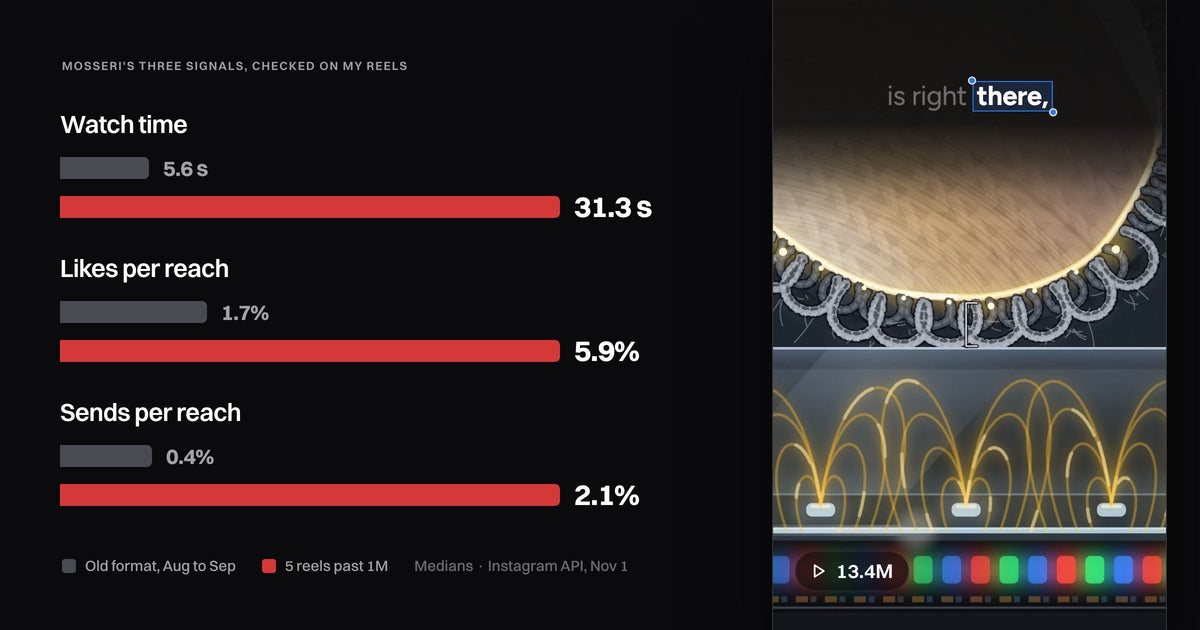
Instagram ranks reels by predicting what each viewer will watch, like and send to a friend. Adam Mosseri, who runs Instagram, called watch time, likes and sends "the top three signals" on Jan 21, 2025 and named sends per reach, likes per reach and average watch time again on Oct 26, 2026. My five Claude Code explainers past 1M views (27.8M together, Instagram API, Nov 1, 2026) bear it out: their median sends per reach was 2.1%, against 0.4% for my old format.
- Three signals, from Instagram itself: watch time, likes and sends. Sends weigh a little more with people who don't follow you.
- All three rose when I switched formats. My reels past 1M held a median 31 s and 5.9% likes per reach, against 5.6 s and 1.7% before.
- Comments and saves didn't track the hits. A comment-for-link reel with 17,065 comments stopped at 306K views.
- Some of it my data can't show: DM sends alone, followers vs strangers, skip rate, or cause.
How does the Instagram algorithm work in 2026?
There isn't one algorithm. Feed, Stories, Explore and Reels each rank with their own, and most of what you see in Reels comes from accounts you don't follow, says Instagram's ranking explained page (May 31, 2023).
For each viewer, the Reels system gathers candidate reels, keeps about 100 with a light model, predicts how that person will react to each, then sorts them by score, per Meta's Reels system card (updated Nov 11, 2025). Instagram also surveys people on whether a reel was "worth their time".
Viewers can steer it now. Your Algorithm shows the topics Instagram thinks you like and lets you add or remove them, on Reels since Dec 10, 2025 and across Feed, Reels and Explore since Jun 10, 2026 (Instagram).
Go deeper: every Instagram statement in this guide, by date
May 31, 2023: Instagram ranking explained, by Mosseri. Jan 21, 2025: Mosseri's reel on the top three signals. Nov 11, 2025: Meta's Reels system card. Apr 30, 2026: Mosseri's originality reel. Jun 10, 2026: Your Algorithm across Instagram. Oct 26, 2026: Mosseri on The Colin and Samir Show (ranking from 34:57, sends per reach from 45:50). All read or watched Nov 1, 2026.
Adam Mosseri's three ranking signals: watch time, likes, sends
On Jan 21, 2025 Mosseri posted: "the top three signals that matter most for ranking are watch time, likes and sends. So when looking at your insights, pay close attention to average watch time, likes per reach, and sends per reach." Likes count a bit more with followers, sends with everyone else.
On Oct 26, 2026 he said it again on Colin and Samir's show: sends per reach "matters a ton", "particularly for unconnected reach", meaning people who don't follow you. He added one nuance: "We focus way less on watch time than all the competition does, but we do care about watch time."
Sends per reach is a reel's shares divided by its accounts reached. Mosseri said Edits already does that math and Insights is next.
Mosseri's signals checked against my reels
On my account, the three signals Mosseri named are the three that moved. I divided every count by accounts reached for all 80 posts from Aug 1 to Nov 1, 2026. Since Sep 28 most are animated explainers written by Claude Code with Full Visual and rendered to MP4.
| Signal | What Instagram says | Old format, 37 reels | 5 reels past 1M | On my data |
|---|---|---|---|---|
| Watch time | Top three (Jan 2025) | 5.6 s | 31.3 s | Rose |
| Likes per reach | Top three, more with followers | 1.7% | 5.9% | Rose |
| Sends per reach | Top three, more with non-followers | 0.4% | 2.1% | Rose |
| Saves per reach | An input signal, not top three | 1.5% | 1.3% | Flat |
| Comments per reach | Predicted, not in the top four (2023) | 0.11% | 0.02% | Fell |
Across all 80 posts, the ones that reached more people had higher watch time, likes per reach and sends per reach (rank correlations 0.78, 0.76 and 0.72). Saves (0.51) and comments (0.22) tracked reach far less.

Go deeper: how these numbers were made
Instagram's media insights API for @speedy_devv, refreshed Nov 1, 2026. "Sends" is the API's shares count ("Number of shares of the reel"). Old format: 37 posts, Aug 1 to Sep 27. The five reels past 1M: touchscreen 13,407,906 views, phone keyboard 10,021,802, laptop battery 1,543,057, AirPods noise cancelling 1,509,950, PS5 on a PC 1,360,300. All 43 posts since Sep 28: median sends per reach 1.36%, average watch 25.1 s. Correlations are Spearman ranks against accounts reached.
Sends per reach: what every reel past 1M had in common
Each of my five reels past 1M got 1.7 to 2.9 sends per 100 accounts reached. The old format's median was 0.4.
The phone keyboard reel: 174,828 sends on 8.1M accounts reached (Instagram API, Nov 1).
What gets a reel sent shows on screen: a question about something the viewer holds every day, answered in pictures, the kind you forward with "did you know this?". That matches Mosseri's point that sends matter most with strangers. My profile showed 182K followers on Oct 28 (Instagram app). Most of the people that reel reached had never followed me.
Average watch time: seconds held, judged against reels of the same length
One of Instagram's watch-time predictions compares you with reels of the same length. Meta's system card lists a prediction for whether you'll watch more of a reel "than 95% of users who watched reels of the same length".
My old 7 to 10 s clips were watched 69% through, a median 5.6 s, and stalled at a median 3,075 views. The five reels past 1M ran 78 to 107 s and held 30 to 38 s, 34 to 41% of their length (Instagram API, Nov 1). What counts as good here: average watch time on reels.
The first seconds feed a separate prediction: whether you'll watch under 3 seconds, built partly from skips within two seconds of opening.
 0 s
 0.5 s
 1 s
 2 s
 3 s
Do comments and saves help reach on Instagram?
They count, but on my account neither separated the hits. Instagram's 2023 page names the four Reels predictions that matter most: reshare, watch to the end, like, and go to the audio page. Comments and saves aren't among them.
Saves per reach: a median 1.3% on the five reels past 1M, against 1.5% before. Mosseri still lists comments among the things Instagram values (Oct 26, 2026), so read this as "not decisive", not "comments hurt".
Originality, breakouts and recency: what Mosseri added for 2026
"People think we rank just to drive engagement, but we actually rank for a lot of other things," Mosseri said on Oct 26, 2026. He named originality (more distribution to the creator than to aggregators), breakouts ("a brand new account can get millions of views, which was impossible 2 years ago") and recency.
Originality has teeth. An account that mostly shares content it didn't make or meaningfully edit isn't recommended to people who don't follow it; on Apr 30, 2026 Mosseri extended that reels policy to photos and carousels. The 2023 page already made watermarked, low-resolution and reposted reels less visible.
 On "a plane engine"Engine, AirPod and eardrum, all drawn as code.
 On "called KytyPS5"The real project page, redrawn.
A reel Claude Code writes and renders from nothing has no other app's watermark and isn't a re-upload. The rules in depth: faceless reels and Instagram's originality rules. If your views fell and you want the checks in order: reels not getting views.
Which signals a Claude Code explainer earns
On my data, a Claude Code explainer earns the two signals that ask the most of a viewer, staying and sending, and the likes come with them.
What the viewer gets: a question about something they own, answered in 78 to 107 seconds, with the real object or interface redrawn and moving on the word that names it. They stay for the answer, then forward it. How Claude Code makes one, layer by layer: how people make those Claude reels. By hand, CapCut or Edits will cut a reel, but every picture that moves on a word is yours to build.

Full Visual
Explain any subject, word by word. A voice, a synced caption and real interfaces moving on every word.
What my data can't show
- DM sends alone. The API's shares count every share of a reel, not only sends in DMs.
- Followers vs strangers. Mosseri weighs likes and sends differently for each, and my export doesn't split reach that way.
- Skip rate. Meta lists a 3-second skip metric as still in development. It isn't in my numbers.
- Cause. One account, one niche, correlation only. A reel shown to more people also changes its own ratios.
- Recency and the weights. I have no day-by-day views here, and Instagram publishes no weights.
Questions
What are the most important Instagram ranking signals in 2026?
Watch time, likes and sends, per Adam Mosseri on Jan 21, 2025 and again on Oct 26, 2026. Track them as average watch time, likes per reach and sends per reach.
How do I calculate sends per reach?
Divide a reel's shares by its accounts reached, both in the reel's Insights. Five shares on 1,000 accounts is 0.5%. My five reels past 1M ran 1.7% to 2.9%.
Can you reset the Instagram algorithm?
You can steer it. Tap the icon with two lines and hearts at the top of Reels or Explore to open Your Algorithm, then add or remove topics. Since Jun 10, 2026 it applies to Feed, Reels and Explore together.
Why is my reach suddenly down in 2026?
Check Account Status first: accounts that mostly repost others' content aren't recommended to non-followers, and since Apr 30, 2026 that covers photos and carousels too. The full order to check is in reels not getting views.
Instagram's statements read on about.instagram.com, Meta's Transparency Center, Meta's developer docs and Mosseri's own posts, and his Oct 26, 2026 interview watched on YouTube, all on Nov 1, 2026. Per-reel numbers: Instagram API for @speedy_devv, 80 posts from Aug 1, refreshed Nov 1. Followers: Instagram app, Oct 28.