
AI motion graphics generator that doesn't look like AI slop
Claude Code with Full Visual writes motion graphics as code, voiced and captioned on every word. Real views, plus HeyGen, InVideo and Pictory compared.

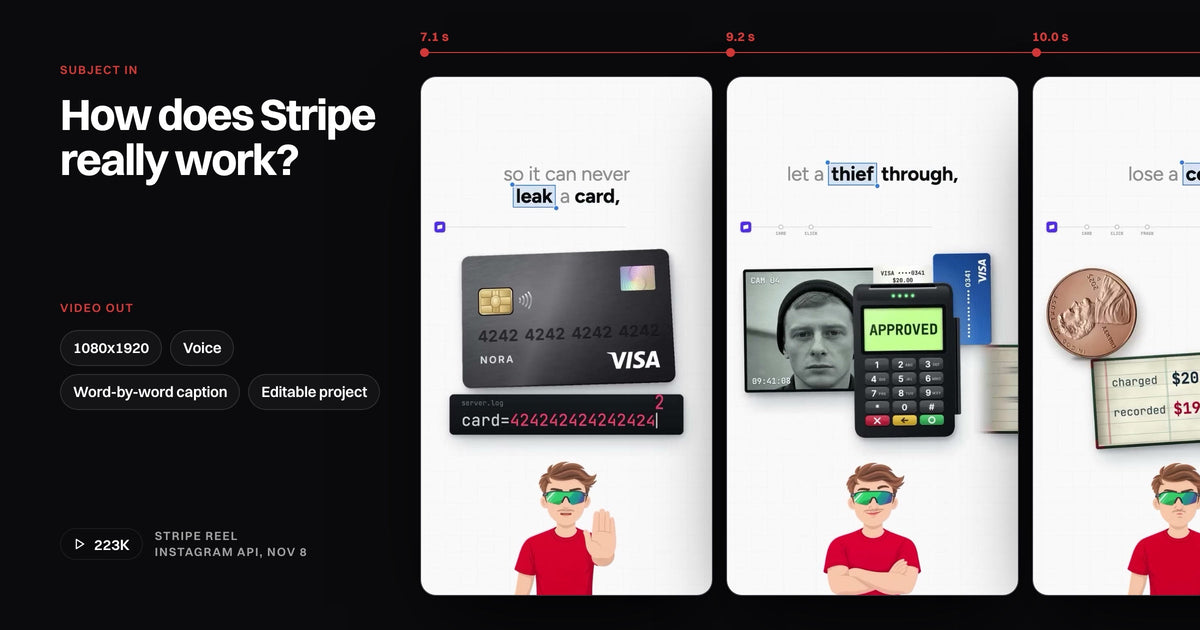
Yes, there is an AI motion graphics generator that doesn't look like AI slop: skip generated footage and have an AI agent write the motion graphics as code. Mine is Claude Code with Full Visual. Give it a subject; it writes the script, makes the voice, draws every scene on its word and renders a finished 1080x1920 video with a word-by-word caption. My touchscreen reel made this way has 13.5M views (Instagram API, Nov 8, 2026). HeyGen, InVideo and Pictory build videos from avatars, video models or stock footage instead.
- Code, not generated footage. Every word, number and interface is drawn on purpose, so nothing looks like stock or an avatar.
- A subject in, a video out. A topic, a link or your transcript goes in; the video, caption, cover and editable project come out.
- Motion on the word. The picture changes as the voice names each thing, which is what keeps it from being a slideshow.
- The alternatives, from their own pages. HeyGen leads with avatars, InVideo with video models, Pictory with stock footage. Free code routes leave the script, voice and timing to you.
Is there a way to make AI video that doesn't look like AI slop?
Yes: make it from code instead of generated footage, and build each picture around what is being said. That question was asked word for word on r/generativeAI (Sep 14, 2026). One reply: "Using text to video is sure fire way to get labeled slop." The top one: "A great story is what makes something not 'slop'."
Developers say the same about code. On Hacker News: "remotion based videos look much better imo since it can code much better than it can prompt for videos with a coherent narrative" (Jul 16, 2026).
Motion graphics generators split the same way: some draw editable layers or code, others paint with video models such as Veo, Kling and Seedance. Anthropic's own Claude Motion is covered in Claude motion graphics examples.
An AI motion graphics generator from text: Claude Code with Full Visual
Full Visual is a folder you open in Claude Code or Codex, on Mac or Windows. You bring a subject: a sentence, a link to an article, or your own transcript, which is taken as written. Your agent researches it, writes the script with five hooks, makes the voice, draws every scene on its word and renders the video.
You get the video, its caption and a cover, ready to post, plus the research with every fact linked and the transcript. The project stays editable: change the words, the scenes or the timing and render again. It is $99 (was $199) on Nov 8, bought once.
 7.1 s
 8.1 s
 9.2 s
 10.0 s
 10.8 s
Each thing appears as the voice names it. The whole format, layer by layer: how people make those Claude reels.
Why AI motion graphics still come out as a slideshow
Code alone doesn't fix it. A faceless finance page on TikTok posting "Mostly still AI images with light movement" wrote: "Every one is stuck under 300 views." The top answer: "you need them to be animated" (r/TikTokMonetizing, Oct 14, 2026). A maker whose launch film Claude Code built: "The first result was bad. A slideshow." Their first note back: "Nothing happens. I want the interface to act" (r/ClaudeAI, Oct 14).
A one-line prompt carries the look and leaves out the rhythm: what appears, on which word, for how long. The people who got good wrote those directions down, note after note, in a folder their agent reads every time. Full Visual is that folder, already written.
 On "millions"A few payments cross the globe.
 On "trillion"The counter lands on $1.9 trillion and the globe fills.

Full Visual
Explain any subject, word by word. A voice, a synced caption and real interfaces moving on every word.
Reels this generator made, on any subject
Phones, earbuds, a console, a payments company, football: one folder, one reel per row.
One account and its buyers: a pattern, not a promise. The opening line counts as much as the motion: reel hook examples.
Alternatives to HeyGen, InVideo and Pictory that don't look like generic AI stock footage
The alternative is a generator that draws the picture instead of fetching or generating it. Each row is the company's own page on Nov 8, 2026; I didn't sign up for or run any of them.
| Tool | The picture is made of | Voice | Price |
|---|---|---|---|
| Claude Code + Full Visual | Scenes written as code: real interfaces, numbers and objects, drawn on the word | Yes, on your own ElevenLabs, OpenAI or Fish key. English only | $99 once, plus your Claude Code or Codex plan |
| HeyGen | AI avatars, 500+ ready-made presenters | 1,000+ AI voices, voice cloning | Free: 3 watermarked videos a month, 1 minute each. Creator $29 a month |
| InVideo | Video models (Seedance 2.5, Veo 3.1, Kling) and premium stock footage | Voiceovers | From $10 a seat a month, billed yearly |
| Pictory | Getty and Storyblocks stock footage, stock avatars | ElevenLabs voices | From $25 a month billed yearly, $29 monthly |
Full Visual is the only one here that runs on your own computer and leaves you the project as files. It is also the only one that is English only.
Go deeper: the page behind each row
HeyGen pricing, InVideo text to video and pricing, Pictory pricing (14-day free trial).
Manus AI video editor vs Claude Code for making marketing videos
Manus mixes generated shots with code; Claude Code with Full Visual only draws. Manus's Video Editor launch post (Oct 1, 2026) says it makes "shots from video models like Seedance 2.5, plus images, music, voiceover and sound effects", writes code "for motion graphics, layouts, charts and map routes", and puts every piece on its own track in its desktop app.
For an explainer, the generated shots are the part that reads as AI. Claude Code with Full Visual draws every picture instead: real interfaces, no generated footage, and the view counts above.
AI video maker for marketing workflows that a developer can control with code
Claude Code is one: the video is code in your project, so you change a word, a number or a color and render again. It renders with Remotion, the open-source React video library, so the project is plain code you keep.
A renderer on its own draws nothing. The script, the voice, the timing and what moves on which word are the hard part, and they are what Full Visual adds, written once and read on every reel. Claude Code needs a Claude subscription or Console account; Full Visual also runs in Codex. The renderers compared: HyperFrames vs Remotion.
What you get with Full Visual
- The finished 1080x1920 video, its caption and a cover
- The research, every fact with its link, and the transcript
- The project, to change the words, scenes or timing
- Your look and voice, saved once for every next reel
What you don't
- Generated footage or realistic people
- Music: reels are voice-only, add your own after
- Languages other than English
- Agent and voice usage, billed by your own accounts
- A licence for teams of 4 or more: it renders with Remotion, which asks $25 a month per seat
Questions
Is there a free AI motion graphics generator?
Free plans exist, usually watermarked or capped at a few short videos a month: HeyGen's free plan is 3 watermarked videos of 1 minute each (Nov 8). Full Visual is $99 once (Nov 8), with no watermark and no monthly cap, plus your own agent plan and voice key.
Can it make motion graphics in my own look?
Yes. Your caption style, background and voice are set once and saved, and every next reel uses them.
Can I make these with Codex instead of Claude Code?
Yes. Full Visual runs in Codex the same way; you open the folder in Codex and give it the subject.
Can AI make motion graphics from text?
Yes. Claude Code writes them as code from your words and renders an MP4; browser generators build them from a prompt. Neither needs After Effects.
Every other tool was read on its own pages on Nov 8, 2026, never signed up for or run. GitHub, Remotion and Anthropic facts read Nov 8; Reddit and Hacker News quotes read in their archives, Nov 8. Views: Instagram API for @speedy_devv, Nov 8; Statbolt's count on its reel, Oct 29, shown with its agreement.